
Top 10 Business Ideas in Pakistan for 2026
Most articles on this topic are the same ten ideas copied between sites, each with a confident investment range and profit margin attached that nobody sourced from anywhere.
This one works differently. Every idea below starts from something that measurably changed in Pakistan over the last two years, because a business idea is only worth anything if the conditions around it have shifted. And none of them carry an invented rupee figure, because costs vary so much by city, scale and supplier that any number printed here would be a guess dressed up as research.
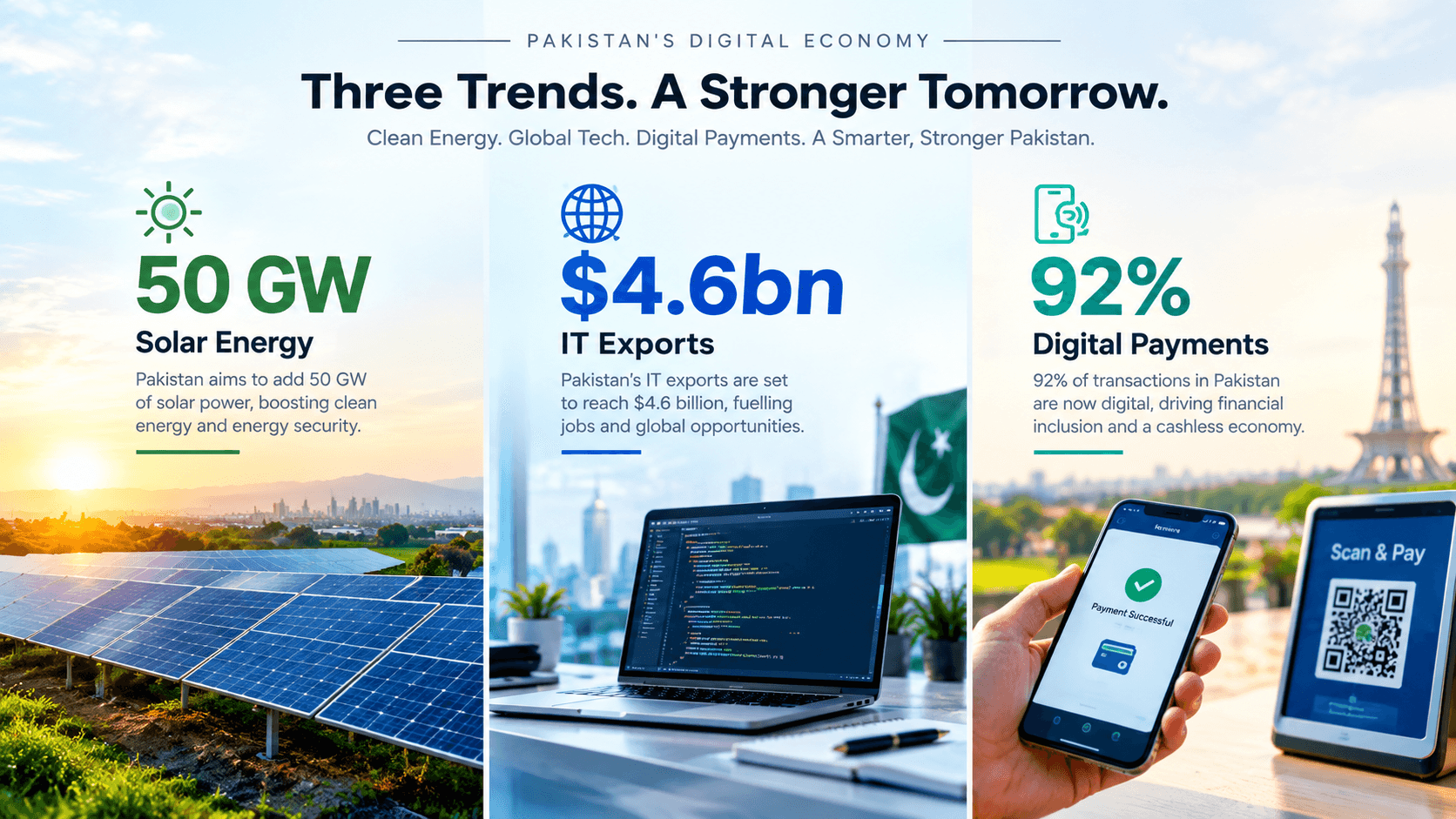
Three changes drive most of what follows:
Pakistan imported over 50 gigawatts of solar panels in five years, worth roughly $18 billion, according to an April 2026 study by the think tank Renewables First. About 38 GW of that was in use as of 2025. The country now has an enormous installed base of equipment that was sold quickly and is mostly unsupported.
IT exports hit $4.6 billion in FY26, up 21% year-on-year, per State Bank of Pakistan figures. Freelance earnings were reported at a record $1.76 billion for the same fiscal year.
Nine in ten retail transactions are now digital. The SBP reported 92% of retail transactions going through digital channels in the January–March 2026 quarter. Raast processed 742.1 million transactions in that quarter alone, and person-to-merchant payments jumped from 36.3 million to 55.9 million in a single quarter small businesses moving onto digital rails.
Each idea below has four parts: why now, who it suits, what it actually takes, and the risk nobody mentions.
1. Solar servicing and maintenance not selling panels
Why now: Pakistan installed tens of gigawatts of solar in a few short years. Almost all of that was a sale, not a relationship. Panels lose meaningful output when dirty and in Karachi, Lahore and most of Punjab, they get dirty fast. Inverters fail. Wiring degrades. Nobody is servicing any of it at scale.
Who it suits: Anyone with electrical skills or willing to train, who can build a small field team. This is a service business, not a trading business.
What it takes: Basic tools, safe roof access equipment, transport, and the ability to explain to a customer why a cleaning schedule pays for itself. Annual maintenance contracts are the real product recurring revenue beats one-off jobs.
The real risk: Roof work is genuinely dangerous and you are liable. Insurance and proper safety equipment are not optional costs you trim to look cheaper than a competitor.
2. Battery storage and hybrid inverter retrofits
Why now: A solar system without storage stops being useful the moment the sun goes down or the grid goes out. As net metering terms shift and tariffs move, more households and small businesses want to store what they generate rather than export it. There is a large installed base of grid-tied systems that were never designed for this.
Who it suits: Overlaps heavily with idea 1the natural second service for the same customer and the same team.
What it takes: Deeper technical knowledge than cleaning, real supplier relationships for batteries, and honest capacity sizing. Oversizing a battery to increase the invoice is the fastest way to destroy referrals in a market where everyone asks their neighbour first.
The real risk: Battery quality in this market varies enormously, and you inherit the warranty problem. A cheap cell that fails in eighteen months is your reputation, not the importer's.
3. A productised freelance agency, not solo freelancing
Why now: Pakistan has a very large freelance workforce and record export earnings to show for it. But individual freelancers hit a hard ceiling there are only so many billable hours in a week, and competing on hourly rate is a race downward.
The opportunity is assembly: three to five people, one service, one niche, sold as a fixed package rather than hourly. "Shopify store setup for supplement brands" beats "web development."
Who it suits: An experienced freelancer who already has clients and is turning work away.
What it takes: Almost no capital a laptop, a payment route, and the discipline to specialise. The hard part is management, not money.
The real risk: Getting paid across borders remains the operational headache of this entire sector. Sort out your payment and compliance route before you scale, not after.
4. Services for e-commerce sellers
Why now: Thousands of people now sell online in Pakistan, and most are bad at the unglamorous parts product photography, listing copy, catalogue management, inventory, returns, marketplace accounts.
Selling to those sellers is a better business than competing with them. You get recurring revenue, no inventory risk, and a customer who already understands why they're paying you.
Who it suits: Anyone with photography, copywriting, or operations skills. A small studio setup covers photography for dozens of clients.
What it takes: For photography a space, lights, a decent camera. For listing and account management knowledge of how each platform's search actually ranks products, which you learn by doing it.
The real risk: Your clients' businesses are volatile. Many will not exist in a year. Build a wide client base rather than depending on two or three.
5. Digital payments onboarding and bookkeeping for small merchants
Why now: This is the clearest trend in the data. Person-to-merchant Raast transactions rose from 36.3 million to 55.9 million in one quarter. Small merchants are moving onto digital payments quickly and most have no idea how to reconcile them, what records to keep, or what their new, suddenly visible transaction trail means for tax.
Who it suits: Anyone with accounting or bookkeeping training. It also suits someone patient and methodical who is willing to learn it properly.
What it takes: Accounting software, real knowledge of current tax requirements, and a willingness to sit with shopkeepers who are nervous about the whole thing. Trust is the product.
The real risk: You are advising on tax and compliance. Get it wrong and the consequences land on your client and then on you. Know the limits of what you're qualified to say, and work with a registered tax practitioner for anything beyond basic bookkeeping.
6. Practical AI implementation for small businesses
Why now: Every small business owner in Pakistan has heard they should be "using AI" and almost none have any idea what that means for a shop, a clinic, or a distribution business. The gap between the hype and actual implementation is wide, and widening.
The real work is unglamorous: automating a quotation process, setting up a WhatsApp response system, cleaning up a customer database, drafting routine documents faster.
Who it suits: Someone technical enough to build workflows and commercial enough to explain the value in rupees saved per week.
What it takes: Tool subscriptions and the ability to demonstrate a result in the first meeting. Nobody buys this on theory.
The real risk: It's a crowded field of people who have watched a few videos. Differentiating means actually delivering working systems, and being honest when the answer is that a given task doesn't need AI at all.
7. Local digital visibility services for small businesses
Why now: Most Pakistani small businesses are invisible in local search no Google Business Profile, inconsistent contact details across the web, no website or a very slow one. The fix is well-understood and the demand is broad.
Disclosure: This is part of what Green Pages does, so weigh the recommendation accordingly. It's on the list because the opportunity is genuinely large and under-served, not because it's crowded and a crowded market is usually a sign of a real one.
Who it suits: Someone willing to learn local SEO properly rather than selling packages they can't deliver.
What it takes: Skill more than capital. Our local SEO guide (/blog/local-seo-guide-pakistan) covers the whole method; the business is applying it repeatedly for clients who won't do it themselves.
The real risk: The sector has a credibility problem created by people who sell retainers and deliver nothing. You will spend your first year overcoming scepticism earned by somebody else.
8. Home healthcare and elder care
Why now: Urban families are smaller and more dispersed than a generation ago, and the informal support that used to cover an ageing parent often isn't there. Hospital care is expensive and overloaded. There's very little structured provision in between.
Nursing visits, post-operative care, physiotherapy at home, dementia support, medication management.
Who it suits: Qualified nurses, physiotherapists, or someone who can recruit and properly supervise them.
What it takes: Qualified staff, genuine background verification, clear protocols, and transport. This is a trust business operating inside people's homes reputation is the entire asset.
The real risk: The liability is real and the emotional weight is heavy. One bad hire can end the business. Verification and supervision cannot be where you economise.
9. Single-product food manufacturing
Why now: Opening a restaurant is capital-heavy and brutally competitive. Making one product extremely well and selling it through delivery, retail shelves and corporate orders is a different business with a different cost structure.
One sauce. One bakery item. One frozen product. Done consistently.
Who it suits: Someone who can actually cook at consistent quality and is willing to do the same thing every day for two years.
What it takes: A compliant production space, proper packaging, and food safety registration. Shelf life and packaging are what separate a home kitchen from a product business, and they're where first-time founders underestimate the work.
The real risk: Scaling kills consistency. The thing that made your product good at ten units a day frequently breaks at five hundred, and customers notice immediately.
10. Post-harvest processing and small-scale cold storage
Why now: A substantial share of Pakistan's fruit and vegetable output is lost between the field and the market for lack of basic handling, drying, grading and cold storage. The gap has existed for decades. What's changed is that solar has made running a small cold room in an area with unreliable grid power genuinely viable which connects this idea directly to the first two on the list.
Who it suits: Someone with rural or peri-urban access, land or a lease, and patience. This is the most capital-intensive idea here and the slowest to return.
What it takes: Real capital, equipment, power increasingly solar and buyer relationships established before you build, not after.
The real risk: The highest of anything on this list. Agricultural margins are thin, buyers can be unreliable, and a single equipment failure during a season can cost you the year's crop. Do not start this one with borrowed money and optimism.
The ideas we left off, and why
Being clear about what we didn't include is more useful than padding the list:
Dropshipping. Pakistani payment and shipping constraints make the standard model difficult, margins are thin, and the people making real money from it are mostly selling courses about it.
Crypto trading. Not a business. It's speculation with a regulatory picture that remains unsettled.
Generic reselling from wholesale markets. No advantage, no moat, competing purely on price against people with deeper pockets and better supplier terms.
"Start a YouTube channel." A channel is a marketing asset, not a business model. It can support a business beautifully. It is not one by itself.
How to pressure-test any of these before spending money
An idea from a list is worth very little. What matters is whether it works for you, in your city, with your resources. Before you commit:
Find ten people who would pay. Not friends being polite ten real prospects who confirm the problem and respond to a price. If you can't find ten, you won't find a thousand.
Sell one before you build anything. Take a deposit, do the job manually, deliver it badly if you must. The lesson from one real paying customer beats a month of planning.
Cost it out honestly. Rent, equipment, stock, transport, utilities, staff, and the months of your own living expenses before it pays you. Add 40% for what you missed everyone misses something.
Name your unfair advantage. A skill, a contact, a location, a supplier relationship, a piece of equipment you already own. If you have none, you're competing on price alone, and someone with more capital will win that.
Decide your failure point now. How much money and how many months before you stop? Writing it down while you're calm is the only protection against doubling down while you're not.
Where to start
The common thread across every idea on this list is that the opportunity comes from a change that already happened solar panels already on roofs, payments already going digital, exports already growing rather than a change someone hopes is coming. That's the difference between a business and a bet.
Whichever direction you take, your first customers will be local, and they'll find you the way everyone finds anything now: by searching. Get your business listed and findable from day one rather than six months in.
Starting something? List it free on Green Pages (/signup) once you're trading it takes a few minutes and it's the first place local customers look. Or read our guide to local SEO for Pakistani businesses (greenpagespk.com/blog/local-seo-guide-pakistan) to get found before your competitors do.
Comments
Loading comments…
Sign in to join the conversation.