
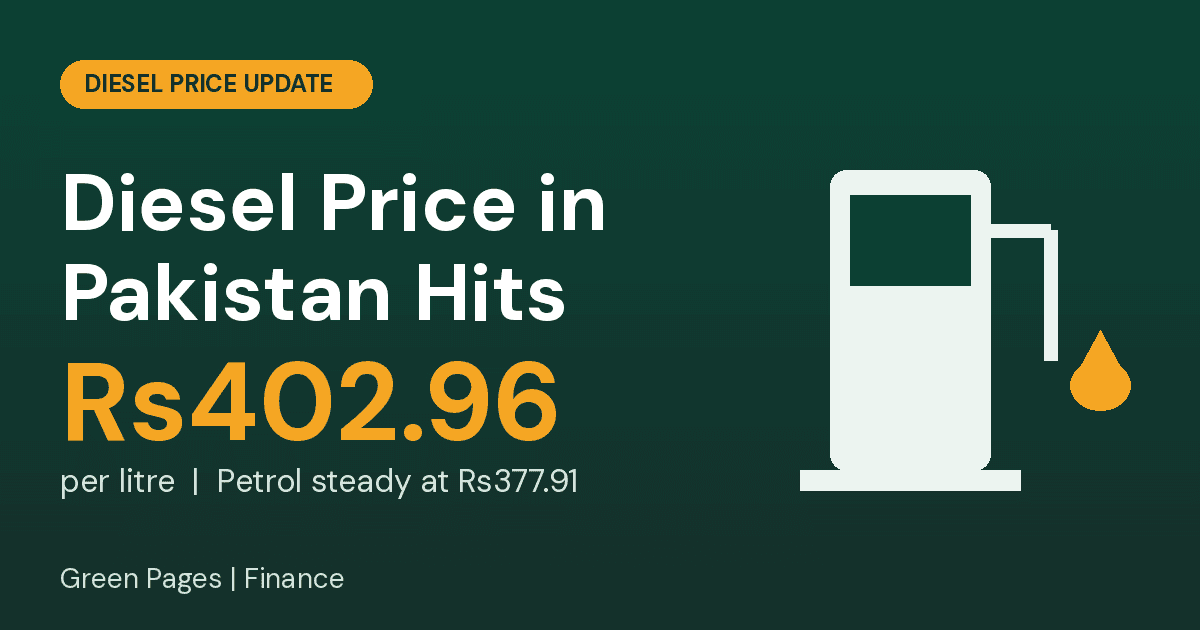
Pakistan's diesel price has moved above Rs400 per litre, while petrol has stayed flat. The federal government raised high-speed diesel by Rs2.29 per litre, taking it to Rs402.96. Petrol remains at Rs377.91 per litre. The new rates apply from 31 October to 2 November 2026, according to reports citing the Oil and Gas Regulatory Authority (OGRA).
This article explains what changed, why it happened, and what it may mean for households, transporters, farmers and small businesses. It is general information only.
What changed in fuel prices
Here are the figures reported by Pakistan Today and Daily Pakistan on 30 and 31 October 2026:
High-speed diesel: Rs402.96 per litre, up Rs2.29 from the previous rate.
Petrol: Rs377.91 per litre, unchanged across both recent revisions.
Validity: 31 October to 2 November 2026.
The latest rise came one day after diesel was increased by 85 paisa per litre, which had already pushed it above Rs400. Put together, diesel became Rs3.14 per litre costlier in just two days, based on the figures reported by Daily Pakistan. Petrol did not move in either revision.
The gap between the two fuels is now Rs25.05 per litre, with diesel the more expensive of the two. That is a useful number to remember, because diesel is the main fuel for trucks, buses, tractors and tube wells.
Why diesel went up
Pakistan imports most of its petroleum needs. That means local prices follow global crude oil rates, freight costs and the exchange rate. Reports say international oil prices have stayed volatile because of tensions in the Middle East, worries about shipping routes and uncertainty about supplies.
Daily Pakistan also linked the latest increase to fears of wider conflict involving Iran and the United States, and to an attack on an oil tanker in the Strait of Hormuz, one of the world's most important oil shipping routes. The same report said global oil prices were heading towards a fourth monthly gain.
When traders fear that supply may be disrupted, crude prices tend to rise. Pakistan's pricing system then passes part of that change on to local consumers.
How the daily pricing system works
According to Pakistan Today, the government introduced a daily petroleum pricing mechanism in July 2026. It replaced the older weekly system. The idea is to reflect global changes faster, so that price gaps do not build up over a week.
For consumers, this means prices can change more often. Some revisions are small, such as the 85 paisa move, while others are larger. It also means that the figure you see today may not be the same next week, so it is worth checking the latest official notification before planning a large fuel purchase.
Relief measures announced
The government has also announced targeted fuel relief for lower-income groups, as reported by Pakistan Today. Under the scheme, eligible motorcycle and three-wheeler users can receive a subsidy of Rs100 per litre on up to 20 litres of fuel a month. Owners of cars with engines up to 800cc can receive the same relief on up to 30 litres.
The report adds that fuel conservation measures have been brought back, including reduced operating hours for markets, shopping centres and other commercial establishments. Eligibility rules and how to claim the subsidy should be checked on official government announcements.
What this means for you
The impact depends on how you use fuel. Here are some practical points.
Daily commuters: Petrol has not changed, so car and motorcycle running costs are steady for now. Bike and rickshaw owners may want to check whether they qualify for the Rs100 per litre relief.
Transporters and traders: Diesel drives freight costs. A rise of Rs3.14 in two days can slowly feed into delivery charges, especially if it continues. Reviewing your route plans and delivery schedules may help control costs.
Farmers: Tractors and tube wells often run on diesel. Higher diesel rates can add to the cost of ploughing, irrigation and moving crops to market.
Small businesses: If your business depends on deliveries, keep a simple monthly record of fuel spending. It will show you quickly whether higher prices are affecting your margins.
Household budgets: Higher transport costs can push up the prices of vegetables, fruit and other goods over time. Tracking your grocery spending for a few weeks can show whether this is happening.
None of this is a prediction. Fuel prices can go up, stay flat or fall depending on global markets and government decisions.
Simple ways to manage fuel costs
You cannot control the price at the pump, but a few habits can reduce how much fuel you use:
Combine errands into one trip instead of several short ones.
Keep tyres at the recommended pressure and service your vehicle on time.
Avoid heavy idling and sudden acceleration.
Share rides with colleagues or neighbours where possible.
For businesses, plan delivery routes to cut empty return trips.
What to watch next
The current rates are valid until 2 November. After that, a new notification is expected under the daily pricing system. Developments in the Middle East, global crude prices and the rupee will all influence the next revision. For official rates, readers can check OGRA and the Ministry of Energy announcements.
Summary
Diesel in Pakistan is now Rs402.96 per litre after a Rs2.29 increase, while petrol is unchanged at Rs377.91. The rise follows global oil market worries and fresh Middle East tensions. Transporters, farmers and small businesses are the most exposed, and targeted relief is available for some motorcycle, rickshaw and small-car users. Keep an eye on official notifications, and plan fuel use carefully.
This article is for general information only and is not financial advice.
Comments
Loading comments…
Sign in to join the conversation.