
The Lahore-Born Co-Founder Behind 2026's Biggest Pakistan-Linked Funding Round
On 24 August 2026, Fasset announced a $68 million Series C led by SBI Group, at a valuation of $1 billion.
That makes it a unicorn, the venture industry's term for a private company valued at a billion dollars or more. One of its two co-founders, Daniel Ahmed, was born in Lahore. For a country whose startup ecosystem has spent three years in a funding winter, it was the best news in a while, and Pakistani social media treated it accordingly.
It is a real achievement, and it deserves the attention. It is also a more complicated story than most of the coverage allowed, and the complications are the interesting part.
What Fasset actually does
Worth establishing plainly, because "AI-powered stablecoin neobanking platform" is not a sentence that explains itself.
Fasset moves money across borders. Its customers in more than 125 countries can hold, send, spend, and invest in different currencies and asset classes through one account. Underneath that sits what the company calls Own Network: a web of banks, payment providers, telcos and settlement networks spanning over 100 banking corridors.
The two technical choices that distinguish it: stablecoins are used as settlement infrastructure inside parts of that network, and transactions are routed by software that picks a path based on cost, speed, and availability rather than following a fixed correspondent-banking chain.
In plain terms: international transfers are slow and expensive because they pass through a chain of banks that each take time and a cut. Fasset is building a way around that chain.
The company was founded in 2019 by Mohammad Raafi Hossain, who is co-founder and CEO, and Daniel Ahmed. It is headquartered in Dubai and operates through regulated entities across the GCC, Asia, and Europe.
The Series C follows a $51 million Series B in May 2026. That's $119 million raised in a single year, and more than $150 million in total.
The Pakistan question, answered honestly
Headlines in Pakistan called this the country's first unicorn. That framing doesn't survive contact with the details, and it's worth being precise about why not to diminish the achievement, but because accuracy is the whole value of writing about this at all.
What's true: A Lahore-born entrepreneur co-founded a company now valued at a billion dollars. Fatima Gobi Ventures, a Pakistani VC firm, was an earlier investor. In February 2026, Fasset announced a partnership with Habib Rafiq Limited, the Pakistani infrastructure and real estate group, to enter the Pakistani market by tokenising real-world assets targeting what has been estimated as a $1.5 trillion domestic real estate and asset market. Pakistan's IT Minister attended the announcement.
What's not: Fasset is a Dubai-headquartered company. It raised its money from global investors, built its product for global markets, and scaled outside Pakistan's domestic ecosystem. Its Pakistan operations are, as of now, announced plans rather than delivered products.
The honest description is a global fintech unicorn with a Pakistani-born co-founder and announced plans for Pakistan. That is still a significant thing. It demonstrates that Pakistani founder talent can build at the highest level of global fintech, which is not a small claim to be able to make.
What it doesn't demonstrate is that a company can be built in Pakistan and scaled to that valuation from there. That remains unproven, and it's the gap that actually matters for anyone starting something here.
The number nobody is quoting
Here is the statistic that tells you more about Pakistan's startup ecosystem than the valuation does.
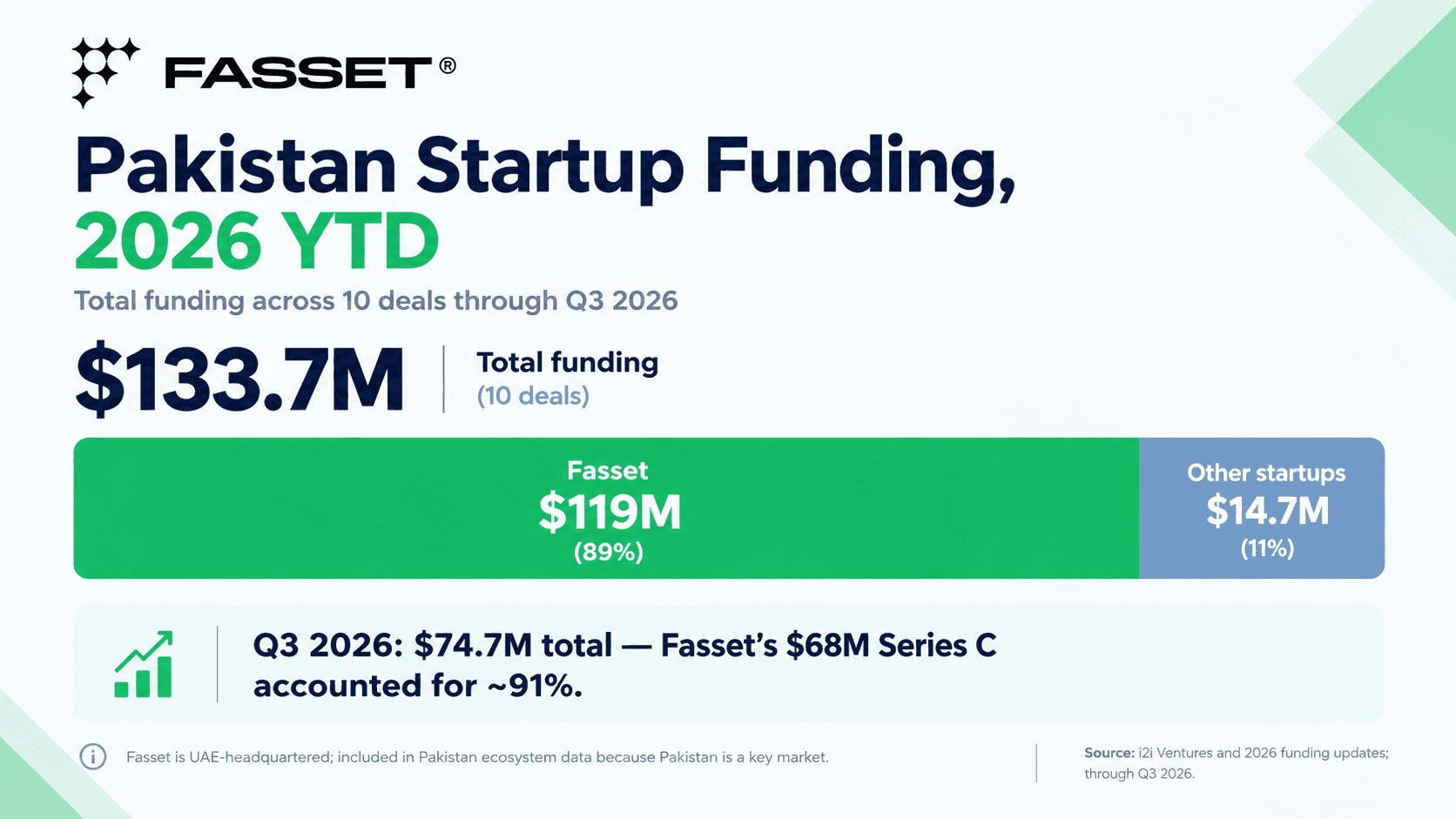
Pakistani startups raised $133.7 million across 10 deals in 2026 through the third quarter, according to i2i Ventures. Q3 alone accounted for $74.7 million across five deals.
Fasset was roughly 91% of that Q3 figure. Strip it out, and every other Pakistani startup combined raised about $6.7 million in the quarter.
The first-half picture is the same shape: around $59 million across five companies, of which Fasset's Series B was roughly 86%. That H1 total is essentially flat against H1 2025's $58.5 million.
So the headline reads as a recovery. The underlying data says something else: one company having an exceptional year, and an ecosystem around it that is roughly where it was twelve months ago.
Both facts deserve to be stated in the same breath. Celebrating the first while ignoring the second produces the kind of optimism that doesn't survive the next funding cycle.
Who else actually raised in 2026
The companies in that remaining $6.7 million are, for most readers here, the more relevant story because these are businesses being built in Pakistan, for problems that exist in Pakistan.
Uplift AI raised a $3.5 million seed round in January 2026, led by Indus Valley Capital and Y Combinator. It builds AI voice agents for regional languages — which, in a country where a large share of the population is more comfortable speaking than typing, and more comfortable in Urdu or a regional language than in English, is a genuinely foundational problem to be working on.
Revora, formerly MyAlice, raised $2 million in June 2026, led by i2i Ventures and Oraseya Capital, building AI revenue agents for e-commerce.
BuyPass.ai raised an undisclosed pre-seed in June 2026 from Myco Holdings and Daman Investments, in live commerce.
Neem raised an undisclosed pre-Series A led by Epic Angels, in banking-as-a-service.
There was also an exit, which in some ways matters more than any of the rounds. In Q1 2026, inDrive agreed to acquire Krave Mart in an all-stock deal reported at around $45 million. Pakistan's ecosystem has had far more funding announcements than exits, and investors need to see money come back out before they put more in. One acquisition doesn't change the picture, but it's evidence that a path exists.
On the public side, the Pakistan Startup Fund awarded $2 million in equity-free grants to three startups in FY25-26, with grants able to cover up to 30% of a funding round, and the BridgeStart programme fully funded international acceleration for 13 startups with 23 more in progress.
What this means if you run a small business in Pakistan
Most people reading this aren't raising venture capital and never will. The story still matters, in three concrete ways.
Venture capital is not the normal path, and this is the data that proves it. Ten funded deals in nine months, in a country of over 240 million people. The overwhelming majority of successful Pakistani businesses are built on revenue from customers, not on investment, and that is the normal, functional way businesses get built everywhere. A funding announcement is a bet that a company might work one day. A profitable shop is a company that already does.
The problems being funded tell you where the gaps are. Voice AI for regional languages. Cross-border payment rails. Banking infrastructure for businesses that banks don't serve well. Those are funded because they're widespread, expensive problems, which means if you're looking for a business to start, the funding announcements are a useful map of what people are willing to pay to fix.
The infrastructure being built will reach you. Better payment rails, cheaper remittance routes, and more accessible banking tools change the operating conditions for ordinary businesses, usually a few years after the funding headline. The companies raising money now are building the plumbing that small businesses will be using by the end of the decade.
The honest summary
A Lahore-born founder co-built a billion-dollar company. That is worth marking, and the people dismissing it on a technicality are missing something real about what Pakistani talent can do.
At the same time, Pakistan's domestic startup ecosystem raised about $6.7 million in the third quarter of 2026 outside that one company, and is roughly flat year on year. The country has not yet produced a company built and scaled at home to that level.
Both of those are true at once. The first is worth celebrating. The second is the one that determines what happens next.
Building something in Pakistan? List your business free on Green Pages so local customers can find you, or read our guide to local SEO for Pakistani businesses. Most businesses here grow on customers, not funding rounds.
Comments
Loading comments…
Sign in to join the conversation.