
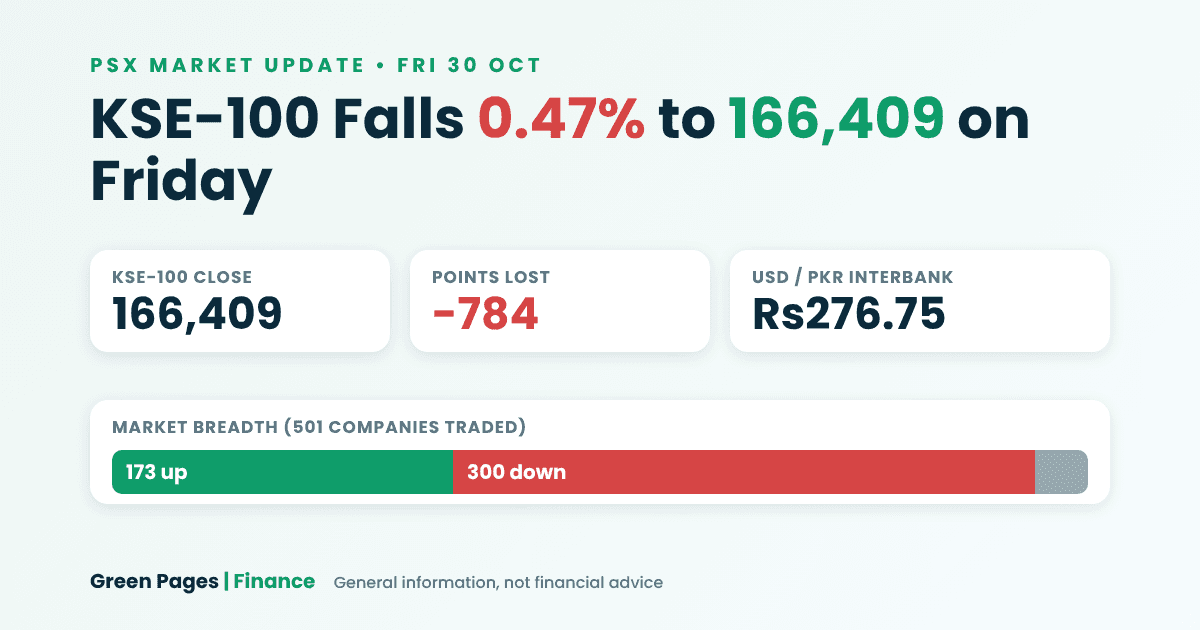
The Pakistan Stock Exchange ended the last trading day of the week in the red. The benchmark KSE-100 index fell 784.19 points, or 0.47%, on Friday 30 October 2026 to close at 166,409.25. This article explains what happened, why traders say it happened, how the rupee moved at the same time, and what it means for ordinary savers and small investors.
How the KSE-100 Closed on Friday
On Thursday 29 October the index had closed at 167,193.44 after a gain of 1,456.68 points, or 0.88%. That means Friday ended a four-day rally. The market was volatile through the day. At one stage the index was up about 145 points, and at another it was down about 866 points before it settled at the lower close.
Other indices also moved lower. The KSE-30 index lost 294.03 points to finish at 49,026.65. The KSE All Share index fell 457.17 points to 100,685.85, and the KMI-30 index dropped 986.42 points to 237,971.74.
Volume, Value and Market Breadth
Trading activity stayed healthy. About 825.46 million shares changed hands, slightly higher than the roughly 816.83 million shares in the previous session. The traded value was Rs23.12 billion, lower than Rs31.54 billion the day before.
Breadth shows how broad the weakness was. Out of 501 companies traded, 173 closed higher, 300 closed lower and 28 were unchanged. Reports said investors lost more than Rs103 billion in market value on the day, and around 60 per cent of listed shares lost value.
Why Shares Fell
Market reports pointed to a mix of reasons rather than one single cause.
Higher crude oil prices linked to tensions between the US and Iran and reports of tanker attacks near the Strait of Hormuz.
Profit-taking after the strong run that followed September-quarter company results.
Worry that higher inflation could lead to another interest rate increase.
Settlement of old contracts during rollover week, which often adds pressure to prices.
Banking and refinery stocks saw much of the selling. UBL, LUCK, HBL, FATIMA and ATRL together took about 359 points off the index. Foreign investors were net sellers of about Rs6.2 billion worth of shares. On the positive side, OGDC reported a 53% year-on-year rise in first-quarter earnings per share to Rs13.60 and announced a Rs5 per share dividend.
October in Perspective
For the full month of October, the KSE-100 finished about 2.09% lower. A single bad day does not change a long-term picture, but it is a good reminder that the market can move both ways within days. A four-day rally followed by a sharp fall is normal behaviour for a stock market, especially when global news is uncertain.
What Happened to the Rupee
The rupee was almost unchanged against the US dollar. In the interbank market it closed at Rs276.75 on Friday, a gain of about one paisa from Rs276.76 the day before. The State Bank of Pakistan reported the more precise close at Rs276.7522, compared with Rs276.7618 on 29 October. Over the week, that rate moved from Rs276.8236 on 23 October to Rs276.7522 on 30 October, a small gain of about 7 paisas for the rupee.
In the open market, the Exchange Companies Association of Pakistan reported closing rates of Rs277.47 for buying and Rs278.62 for selling the dollar. A week earlier, on 23 October, the same rates were Rs277.57 and Rs278.71. Other SBP rates on 30 October were about Rs371.19 for the pound, Rs73.75 for the Saudi riyal and Rs75.35 for the UAE dirham.
The steady rupee is useful for importers and for families who pay school fees or buy goods priced in dollars, because it reduces sudden cost shocks. Remember that actual counter rates at your money changer can differ from the published rates.
What This Means for You
If you invest in shares, one day of falling prices is not a signal by itself. Think about your time horizon, avoid borrowing money to invest and do not put all savings in one stock or sector. If you need money within a few months, such as for a wedding, tuition or a house deposit, a volatile market is generally not the place to keep it.
If you hold dollars or send money abroad, a stable rupee means less rush. Compare rates between your bank and exchange company before you convert, and keep records of your transactions.
If you run a small business, watch the oil price and any interest rate news. Higher fuel prices raise transport costs, and higher interest rates raise the cost of business loans. Planning for these costs early protects your margins.
How to Read a Day Like This
An index point move looks big, but percentage change is the better guide. A fall of 0.47% is modest when the index is above 166,000, even though 784 points sounds large. Volume matters too. When prices fall on high volume, it shows many people are actively selling. When prices fall on thin volume, the move is often less meaningful.
Breadth also helps. With 300 stocks down and only 173 up, the weakness was wide, not limited to a few big names. Compare this with a day when only two or three heavy stocks pull the index down while most shares rise. The second situation is usually less worrying for the broader market.
Simple Habits for Small Investors
Write down why you bought a share and when you plan to review it.
Spread money across sectors instead of chasing one theme.
Keep an emergency fund in a safe place before investing in shares.
Use only trusted, registered brokers and never share your account passwords.
Quick Summary
The KSE-100 closed Friday at 166,409.25, down 784.19 points or 0.47%, ending a four-day rally, with oil prices, profit-taking and interest rate worries cited as reasons. The rupee stayed steady at about Rs276.75 per dollar in the interbank market. Markets move up and down, so make decisions based on your own goals and risk level.
This article is general information, not financial advice.
Comments
Loading comments…
Sign in to join the conversation.