
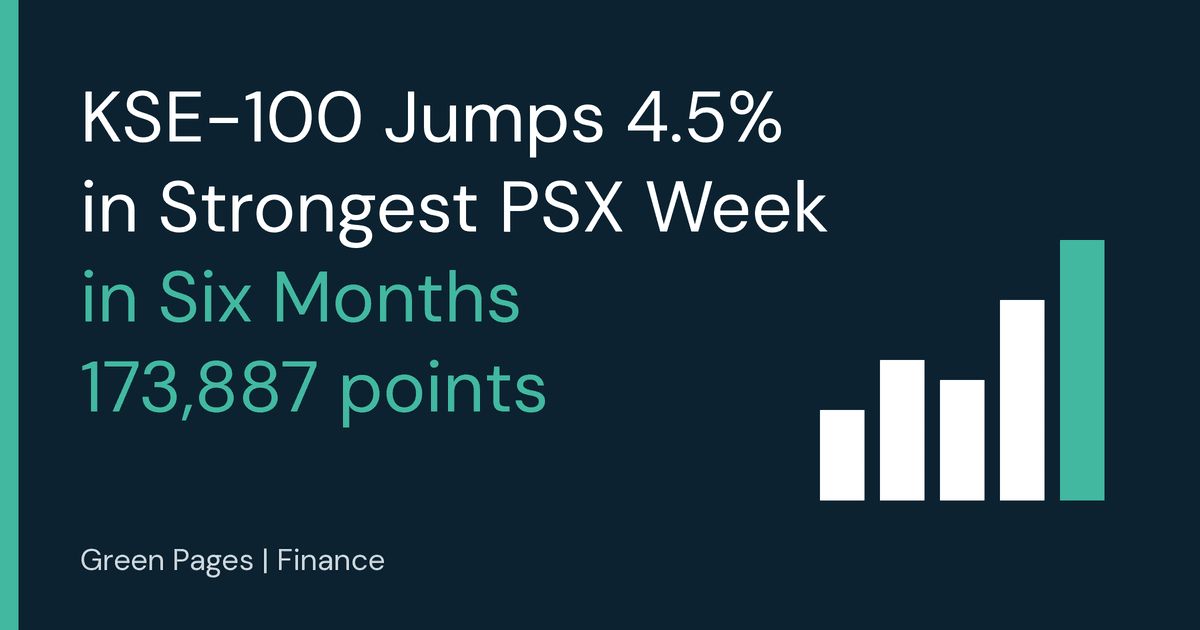
The Pakistan Stock Exchange (PSX) closed last week with its strongest weekly gain in nearly six months. According to a Business Recorder market review published on 9 November 2026, the benchmark KSE-100 Index rose 7,477.44 points, or 4.5 per cent, week-on-week to finish at 173,886.69 points. Falling oil prices, a cut in petrol and diesel rates and easing inflation worries were the main reasons cited. Here is a plain-language look at what moved the market and what it could mean for ordinary Pakistanis.
What happened at the PSX
Investors returned to shares in a broad-based rally after global oil prices dropped sharply. The report linked the fall to Iran's reported openness to diplomatic talks to end the ongoing war, which eased fears about domestic inflation and pressure on the external account. Total PSX market capitalisation rose by 2.8 per cent during the week.
Oil prices and the petrol cut
Brent crude closed the week at USD 98.50 per barrel, compared with an average of roughly USD 115.50 the week before, a drop of about USD 17. The federal government passed some of that relief on to consumers:
Petrol (Motor Spirit) was cut by Rs 25.32 per litre to Rs 352.59 per litre.
High-Speed Diesel was cut by Rs 20.71 per litre to Rs 382.25 per litre.
Lower fuel prices matter beyond the pump. Transport and delivery costs affect the price of food, goods and services, so a sustained fall can help ease inflation over time.
Energy costs still a concern
The report also noted that cost pressures have not gone away. The Central Power Purchasing Agency-Guarantee (CPPA-G) is seeking an increase in the electricity tariff, and the Oil and Gas Regulatory Authority (OGRA) notified a 15.3 per cent increase in re-gasified liquefied natural gas (RLNG) prices. Households and businesses that depend on gas and electricity should keep these pending changes in mind when planning their budgets.
Reserves, IMF and public debt
Liquid foreign exchange reserves held by the State Bank of Pakistan (SBP) rose by USD 39 million to USD 21.56 billion. The Finance Minister said the country's external accounts remain in a comfortable position.
In talks with the International Monetary Fund (IMF), the lender reportedly urged Pakistan to broaden its tax base, while the Federal Board of Revenue (FBR) chairman indicated that the government intends to abolish the super tax. Separately, Finance Ministry data showed that total public debt rose by Rs 6.20 trillion during fiscal year 2026 to Rs 91.00 trillion, equal to about USD 328.64 billion.
Which sectors led the trading
Chemicals accounted for 18 per cent of total market volume during the week, followed by the refinery sector with 11 per cent. Refinery shares were among the weaker names: Cnergyico PK fell 11.3 per cent to Rs 12.10 per share and Attock Refinery declined 9.8 per cent to Rs 982.16. Nestle Pakistan slipped 2.1 per cent to Rs 6,899.58, and Mehmood Textile Mills dropped 2.0 per cent to Rs 125.46.
What this means for you
If you drive or run a transport business: The petrol and diesel cuts reduce running costs, but fuel prices in Pakistan are revised regularly and follow global oil, so do not assume the lower rate will last.
If you run a small business: Check whether your suppliers pass on the lower fuel costs, and prepare for possible increases in electricity and gas bills.
If you invest in shares or mutual funds: One strong week does not guarantee a trend. Markets can reverse quickly, especially when they depend on oil prices and news from the region. Keep your own goals and risk level in mind, and consider speaking to a licensed adviser before making decisions.
If you are saving or planning a household budget: Falling fuel prices and moderating inflation are good news, but the pending energy tariff changes could offset some of that relief.
What to watch next
Over the coming weeks, the key points to follow are the direction of Brent crude, whether Iran's reported openness to talks turns into a real agreement, the decisions on electricity and RLNG tariffs, and the outcome of discussions with the IMF on tax measures. Each of these can move both the stock market and everyday prices.
For many readers, the simplest takeaway is that lower global oil prices can quickly improve sentiment in Pakistan, because fuel, inflation, the rupee and company profits are all connected. At the same time, rising energy tariffs and a growing debt stock remind us that the wider economic picture is still mixed.
Common questions
What is the KSE-100 Index? It is the main benchmark of the Pakistan Stock Exchange and tracks the performance of 100 of its largest listed companies. When it rises, it generally means that share prices on the market are going up.
Why do oil prices affect the stock market? Pakistan imports a large share of its fuel. Lower oil prices reduce the import bill and inflation pressure, which improves the outlook for companies and the economy.
Does a weekly rally mean prices will keep rising? No. A weekly move shows what happened in the past, not what will happen next.
Quick summary
The KSE-100 gained 4.5 per cent last week to close at 173,886.69 points as Brent crude fell to USD 98.50, petrol dropped to Rs 352.59 per litre and diesel to Rs 382.25. Reserves edged up to USD 21.56 billion, but higher electricity and RLNG tariffs may still be on the way, and total public debt reached Rs 91.00 trillion.
This article is a news summary based on a report published on 9 November 2026. It is general information, not investment or financial advice.
Comments
Loading comments…
Sign in to join the conversation.