
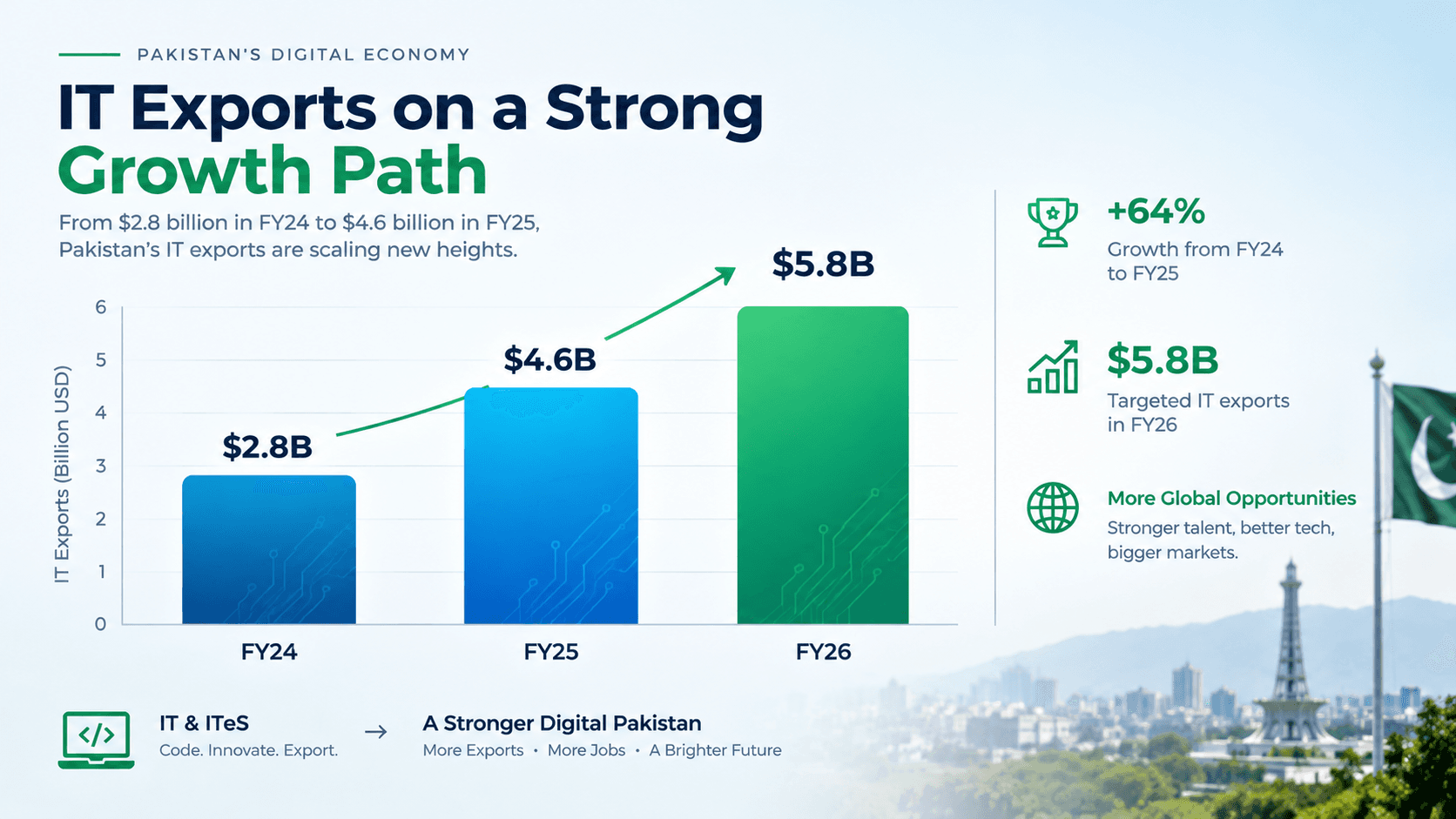
Pakistan's IT Exports Hit $4.6 Billion What It Actually Means for the Economy
Pakistan's IT and IT-enabled services exports reached $4.6 billion in FY26, a 21% increase on the previous year, according to State Bank of Pakistan figures.
The trajectory matters more than any single year:
FY24: $3.2 billion (up 24%)
FY25: $3.8 billion (up 18%)
FY26: $4.6 billion (up 21%)
Three consecutive years of near-20% growth, in an economy where very little else has grown at that rate. That is a genuine achievement, and it deserves to be stated plainly before any of the qualifications that follow.
What it does not deserve is the treatment it usually gets a press release, a round of congratulatory posts, and no examination of what the number is actually made of. So here is the fuller picture: what's driving the growth, how it sits against the rest of the economy, what the headline conceals, and whether it changes anything for a business owner who isn't in tech at all.
Why this number carries more weight than its size suggests
$4.6 billion is not large against Pakistan's overall external accounts. But it matters disproportionately, for three reasons.
It is now the biggest single category of services exports. By the end of FY25, IT accounted for roughly 45% of Pakistan's total services exports a larger share than any other category and ranked as the third-largest source of foreign exchange behind textiles and rice.
It barely costs anything in imports. This is the part that rarely makes the headline and matters most. When Pakistan exports a billion dollars of textiles, a substantial share of that revenue leaves again as payment for imported cotton, dyes, machinery and the energy to run the mills. The net contribution to the country's dollar position is far smaller than the gross figure.
A software engineer in Lahore billing a client in Dubai imports almost nothing. The laptop, some cloud hosting, a few subscriptions. Close to the entire value stays. Dollar for dollar, IT exports do far more for the external account than most of what Pakistan sells abroad which is why a $4.6bn services figure is not comparable to a $4.6bn goods figure and shouldn't be read as though it were.
It scales on people, not plant. Growing textile exports requires mills, machinery, electricity and years of capital expenditure. Growing IT exports requires trained people and an internet connection. In an economy that is chronically short of investment capital and long on young people, that is close to the only growth model available.
What's actually behind the growth
Three things, in rough order of importance.
Cost arbitrage that still has room to run. Pakistani developers, designers, QA engineers and support staff remain cheaper than their equivalents in India, the Philippines or Eastern Europe, and the quality gap has narrowed considerably. Rupee depreciation, painful domestically, made Pakistani labour cheaper in dollar terms a point worth being clear-eyed about, because a significant part of the export growth story is simply a weaker currency making the same work cost less.
Freelancers became a structural part of the sector, not a footnote. Freelance export earnings were reported at a record $1.76 billion for FY2025-26 a substantial share of the total. Pakistan has one of the world's larger freelance workforces, and what began as individuals on Upwork and Fiverr has in many cases turned into small registered agencies with teams and repeat clients.
The sector matured past body-shopping. More Pakistani firms now sell managed services, products and long-term engagements rather than hourly staff augmentation. That means better margins, stickier revenue and some insulation from a client deciding to cut costs in a bad quarter.
The comparison that puts it in perspective
Here is the context that most coverage leaves out.
Pakistan's workers' remittances were $41.6 billion in FY26, up 8.6% from $38.3 billion, per SBP data. Remittances exceeded Pakistan's entire merchandise export bill for the year.
IT exports, at $4.6 billion, are roughly 11% of what overseas Pakistanis send home.
That is not a criticism of the IT sector. It's a correction to a narrative that sometimes implies technology is about to carry the economy. It isn't, and it won't for a long time. Pakistan's external position still rests overwhelmingly on remittances which are themselves a mixed blessing, because they depend on labour markets in the Gulf and on migration policy nobody in Islamabad controls.
The honest framing is this: IT exports are the fastest-growing meaningful line in Pakistan's external accounts, and the one with the most room ahead of it. They are not yet the largest, and treating them as the solution rather than one part of it leads to bad policy and worse expectations.
Four caveats that belong next to the headline
1. Not all of it enters the economy. The State Bank permits IT exporters and freelancers to retain a share of their export proceeds 35% in special foreign currency accounts, to be spent on legitimate business costs abroad. That policy exists for good reasons and the industry fought for it. It also means the declared export figure and the dollars actually converted into the domestic economy are two different numbers.
2. A real amount never gets declared at all. Informal channels still carry part of what Pakistani freelancers earn. The official figure almost certainly understates total earnings which cuts in the sector's favour on size, and against it on anything that depends on knowing the real number.
3. Concentration risk is real. A large share of exports goes to a handful of markets, the United States prominently among them. A downturn there, or a policy shift on outsourcing, transmits to Pakistan quickly. A sector growing 20% a year on a narrow client base is more fragile than the growth rate suggests.
4. The constraint is becoming people, not demand. The binding limit on this sector is increasingly the supply of genuinely employable graduates, and the ease with which the best of them leave. Every experienced engineer who emigrates takes future export revenue with them. Export growth and brain drain are the same story told from two ends.
What this means if you're not in tech
Most readers of this won't run a software house. The number still matters, in four practical ways.
More dollars in the economy is a better operating environment for everyone. A stronger external position means less pressure on the rupee, more room on imports, and a slightly less punishing environment for anyone who buys anything from abroad which is most businesses, directly or not.
A services economy creates local customers. Rising IT and freelance income is concentrated in cities, skews young, and gets spent locally on housing, food, vehicles, education, healthcare, and small services. If you run a café in Gulberg, a clinic in Clifton, or a gym in F-11, a chunk of your customer base is being paid in dollars. That is a real, specific market segment, and one that shows up in local search before it shows up anywhere else.
The export sector needs domestic suppliers. Those firms buy accounting, legal, recruitment, facilities management, catering, transport. A growing export sector pulls a long tail of ordinary local businesses up behind it.
It's a signal about where skills are worth having. For anyone choosing what to study or which business to start, three straight years of 20% growth in a sector that scales on skills rather than capital is as clear a signal as this economy produces.
What would have to happen for this to keep going
Compounding at 20% gets hard. Sustaining it would need some combination of:
A wider market base, so one country's downturn doesn't take the sector with it.
More graduates who are actually employable, which is an education problem, not an IT policy problem.
Predictable tax and forex rules. The single most consistent complaint from the sector is not tax rates but policy that changes without warning. Firms can plan around a known cost; they cannot plan around uncertainty.
Reliable power and connectivity, which remain basic operating risks for Pakistani firms in a way competitors in other markets no longer think about.
Keeping senior people in the country, which depends far more on quality of life and currency stability than on anything the industry can fix by itself.
None of these are new observations. All of them have been in sector reports for a decade. The difference now is that the growth is real enough that the cost of not fixing them is measurable.
The short version
Pakistan's IT exports grew 21% to $4.6 billion in FY26, they're the largest slice of services exports, and dollar for dollar they do more for the external account than almost anything else the country sells.
They are also about a tenth of remittances, partly retained abroad, exposed to a narrow set of markets, and constrained by a talent pipeline nobody has fixed.
Both of those things are true. Any account of this sector that gives you only one of them is selling something.
Building a business in Pakistan's digital economy? List it free on Green Pages so local clients can find you, or read our guide to local SEO for Pakistani businesses the export market is global, but your first customers usually aren't.
Comments
Loading comments…
Sign in to join the conversation.