
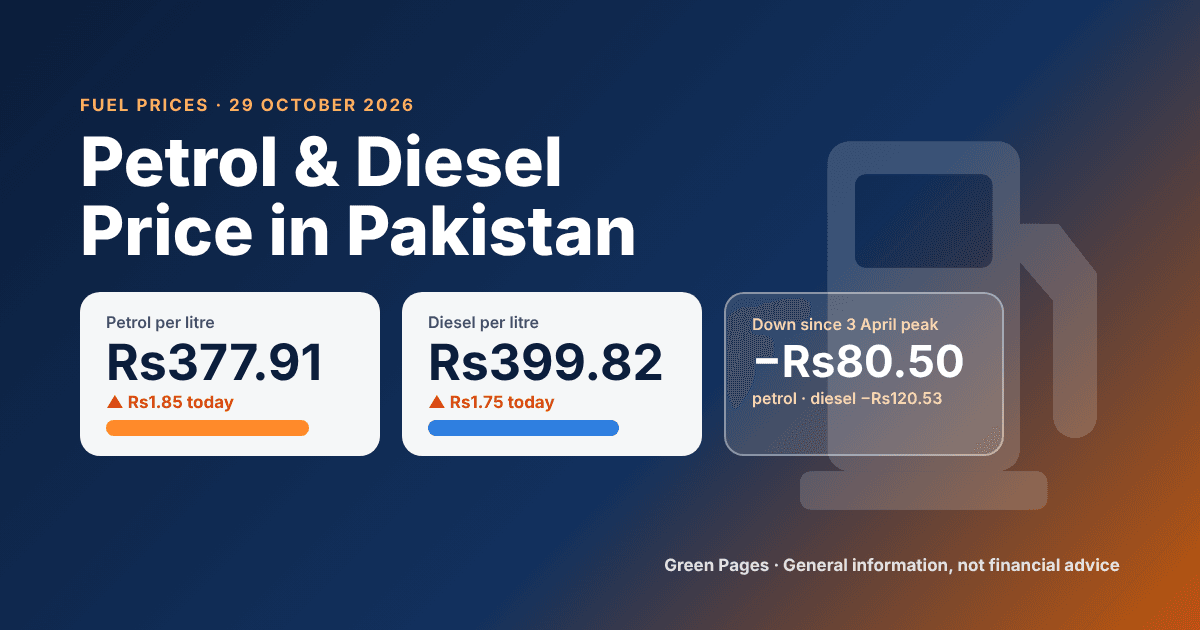
Pakistan's petrol and diesel prices moved in opposite directions earlier this week, and then both went up again. From Thursday, 29 October 2026, petrol costs Rs377.91 per litre and high-speed diesel (HSD) costs Rs399.82 per litre, according to the Petroleum Division notification reported by Dawn. If you drive, ride or run a business that depends on fuel, here is what changed and why it matters.
The new prices at a glance
The latest revision, announced late on 28 October, adds Rs1.85 to a litre of petrol and Rs1.75 to a litre of high-speed diesel. Diesel is now very close to the Rs400 mark.
Petrol: Rs377.91 per litre from 29 October, up Rs1.85.
High-speed diesel: Rs399.82 per litre from 29 October, up Rs1.75.
Taxes and duties: the government still collects Rs114 per litre on petrol and Rs100 per litre on diesel, as reported.
What happened a day earlier
The previous revision took effect on 28 October. Petrol was cut by Rs3.19 to Rs376.06 per litre, which means it had been Rs379.25 before that. Diesel moved the other way, rising Rs2.25 to Rs398.07 per litre, up from Rs395.82.
Put side by side, petrol has gone from Rs379.25 to Rs376.06 to Rs377.91 in three days. Diesel has gone from Rs395.82 to Rs398.07 to Rs399.82. Petrol is therefore about Rs1.34 cheaper than it was before the 28 October cut, while diesel is Rs4.00 more expensive.
Why prices now change so often
Fuel prices in Pakistan are no longer reviewed only every fortnight. Dawn reports that the cabinet and the prime minister gave the Oil and Gas Regulatory Authority (Ogra) the job of setting prices daily, based on international market trends. Dawn's earlier report says daily pricing has been in place since 17 July, after renewed Iran-US hostilities caused sharp swings in world markets.
The swings in the world market are still large. Reuters, in a report carried by Dawn, said Brent crude was trading at $113.72 a barrel on 27 October, down $2.09 or 1.8 per cent, while US WTI crude was $99.83, down $1.93. The fall came as traders focused on Middle East peace talks, but prices stayed close to their highest level in six months.
The articles do not say that the Brent price or the exchange rate directly caused this particular Rs1.85 increase, so it would be wrong to claim a one-to-one link. What we can say is that Pakistan imports most of its fuel, and the daily pricing system is designed to follow international trends.
A look back: how far have prices come down?
Prices are still far above where they were at the start of the year, but well below the spring peak. Dawn reports that petrol was around Rs266 per litre in early March, after the US-Iran war began on 28 February, and peaked at Rs458.41 on 3 April. High-speed diesel started near Rs281 and peaked at Rs520.35 on the same day.
Compared with that peak, petrol is now Rs80.50 lower and diesel is Rs120.53 lower. That is meaningful relief, but a litre of diesel still costs about Rs119 more than it did right after the war began.
Relief schemes and austerity measures
Two policy developments are worth knowing about. First, a fuel relief scheme has covered motorcycles, rickshaws and vehicles up to 800cc since 17 September. Dawn reports that Jamaat-e-Islami chief Hafiz Naeemur Rehman met Prime Minister Shehbaz Sharif on 27 October to demand the abolition of the petroleum levy, and that both sides agreed to form a joint committee to consider expanding the relief scheme. He has said his party would march to Islamabad in mid-November if no major relief is announced.
Second, the government has reintroduced austerity measures. Markets are required to close by 9pm, and fuel allocations for official vehicles have been cut by 50 per cent for three months.
What this means for you
Because prices can change every day, a small rise or fall is normal and should not alarm you. Still, a few practical habits can help.
Everyday drivers: check the day's price on your phone before a big fill-up, since it can differ by a rupee or two from the day before. Over a month those small changes add up.
Small businesses: delivery services, taxi operators and transporters are most exposed to diesel. If you quote fixed prices to customers, consider a clause that lets you adjust when fuel moves beyond a set limit.
Households: fuel costs flow into food and transport prices with a delay, so budget a little extra for the coming weeks rather than assuming the Rs1.85 rise will be the last.
Motorcycle and rickshaw owners: if you qualify for the relief scheme, keep your documents ready, and watch for news from the joint committee about any expansion.
What to watch next
Three things will decide where prices go from here: the direction of crude oil as Middle East peace talks continue, the next daily Ogra notifications, and the outcome of the government and Jamaat-e-Islami discussion on the petroleum levy. Prices could rise or fall, and nobody can promise a direction, so treat any forecast with caution.
Quick summary
From 29 October 2026, petrol is Rs377.91 per litre (up Rs1.85) and high-speed diesel is Rs399.82 per litre (up Rs1.75). Both prices are still well below their 3 April peaks. Brent crude was $113.72 on 27 October, and talks on fuel relief are continuing.
This article is general information, not financial advice. Fuel prices are revised frequently, so always confirm the current rate with Ogra or your fuel station.
Sources: Dawn, "Govt cuts petrol price by Rs3.19 per litre, ups high-speed diesel rate by Rs2.25" (27 October 2026); Dawn, "Diesel price nears Rs400 as govt adds over a rupee to petrol, HSD rates" (28 October 2026); Reuters via Dawn, "Oil prices fall $2 on peace hopes" (28 October 2026).
Comments
Loading comments…
Sign in to join the conversation.