
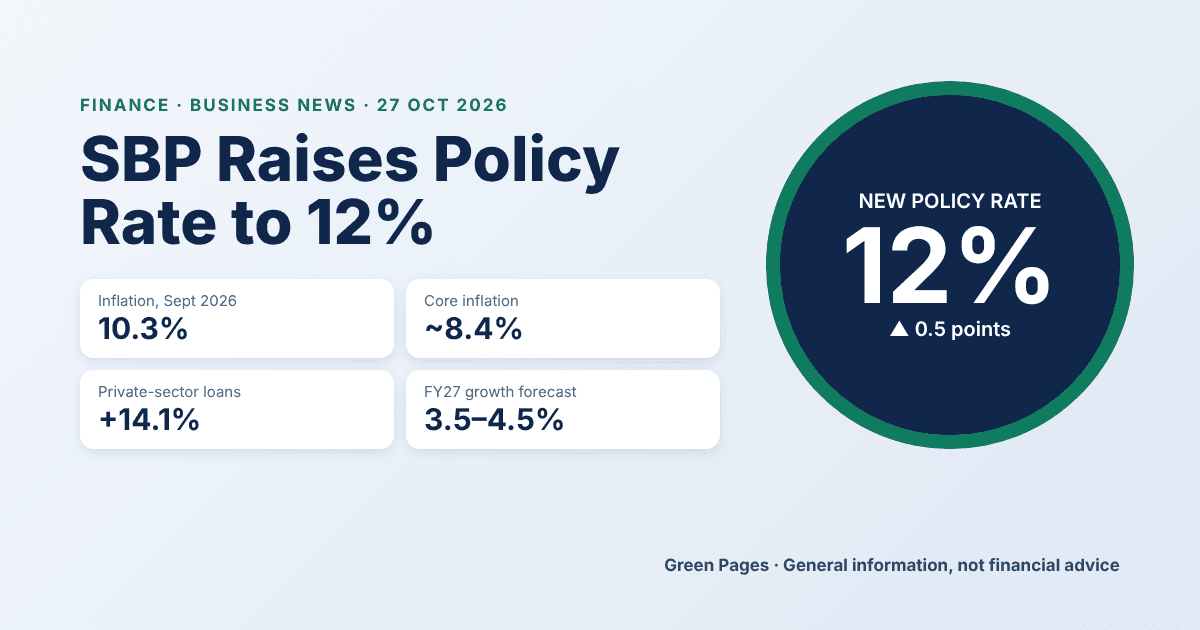
On 26 October 2026, the State Bank of Pakistan (SBP) announced that it is raising its policy rate by half a percentage point, to 12%. The new rate started on 27 October. If you run a business, repay a bank loan, or just wonder why prices keep going up, this decision affects you. This guide explains what happened in simple words, why it happened, and what you can do about it.
What is the policy rate?
The policy rate is the main interest rate set by the central bank. Commercial banks use it as a guide when they decide how much to charge on loans and how much to offer on savings. When the policy rate goes up, borrowing usually becomes more expensive. The goal is to cool down spending a little, so that prices stop rising so quickly.
Why did the SBP raise the rate?
The main reason is inflation. In September 2026, prices were 10.3% higher than a year earlier. That means something that cost Rs1,000 last year costs about Rs1,103 today. The SBP did not expect it to be this high. The bank's target range is 5% to 7%. Core inflation, which leaves out the most unstable items, is also high at around 8.4%.
The central bank pointed to two causes. First, the conflict in the Middle East has become more serious, and there is little hope that it will end soon. This keeps energy prices high around the world. Second, there are supply problems in the domestic wheat market, which push up the price of flour and related products. Nine of the ten members of the Monetary Policy Committee voted for the increase. In their view, it was needed to stop people from expecting prices to keep climbing.
Is the economy still growing?
Yes, but slowly. The SBP shared several signs of recovery:
Large-scale manufacturing grew 1.9% in July and August, compared with only 0.4% in the previous quarter.
Loans to the private sector grew 14.1% over the last year.
The first estimates for the Kharif crops were better than expected.
The SBP still expects the economy to grow between 3.5% and 4.5% in the 2026-27 fiscal year.
The country's foreign currency reserves are steady at about $21.5 billion, which is around three months of imports. On the other hand, the current account recorded a deficit of $874 million in the first quarter, because imports are rising sharply as the economy picks up. Tax collection by the FBR grew 7%, and it beat its target for the quarter.
How did businesses react?
The reaction was divided, and the difference is easy to understand.
The Overseas Investors Chamber of Commerce and Industry (OICCI) supported the decision. Its Secretary General, M. Abdul Aleem, said it was necessary to control inflation and that the SBP was careful by raising the rate by only 0.5 points. He also said that higher rates should come together with cheaper energy, discipline in government spending, and stable tax rules.
Local industry groups were less happy. FPCCI President Atif Ikram Sheikh said the increase would be counterproductive, because inflation is coming from supply problems and energy costs, not from people spending too much. He asked for a rate in single digits, especially to help small and medium businesses. The Karachi Chamber of Commerce and Industry, the SITE Association and the Pakistan Textile Exporters Association made similar points. They said that expensive loans would make it harder to run factories, expand, and compete with exporters in other countries.
In short, foreign investors care most about stable prices, while local manufacturers care most about the cost of borrowing.
What does this mean for you?
If you have a business loan or credit line: check whether your interest rate is linked to the policy rate. If it is, your monthly payment may go up.
If you are planning to borrow: new loans may cost more than they did last month. Calculate your monthly payment first, and make sure you can pay it even if sales are slow.
If you sell products or services: your own costs, such as fuel, electricity and raw materials, may stay high while customers become more careful with money. Watch your margins closely.
If you save money: banks often adjust their savings rates after a change in the policy rate, but this is not automatic, so ask your bank.
Five simple steps for small business owners
List all your loans and write down the interest rate and the due dates.
Collect payments from customers faster, and ask for advance payment where possible.
Talk to suppliers about payment terms before you need extra time.
Delay big expansion plans that depend on new borrowing, unless the numbers are clearly in your favour.
Use low-cost ways to find customers, such as a free business listing, a good Google profile and helpful content on your website.
What to watch next
Over the coming months, keep an eye on three things: the monthly inflation numbers, global energy prices, and the Middle East situation. If inflation falls, the SBP may stop raising rates. If it keeps climbing, more increases are possible. The SBP also warned that bad weather linked to El Niño and unexpected changes in energy tariffs could affect the outlook.
The short version
The SBP raised the policy rate to 12% because inflation, at 10.3%, is well above its 5% to 7% target. The economy is recovering slowly, and reserves are stable. Foreign investors supported the move, while local industry warned that borrowing will get more expensive. For business owners, the best response is simple: know your loans, protect your cash flow, and be careful with new debt.
This article is for general information and is not financial advice. Source: reports by Profit by Pakistan Today, 26 and 27 October 2026, based on the SBP monetary policy statement.
Comments
Loading comments…
Sign in to join the conversation.