
Before anything practical, one sentence, because everything else follows from it.
A loss is not a debt the market owes you. It is money that is gone.
The next trade has no relationship to it. The market does not know your balance, is not aware that you are down, and will not behave differently because you need it to. Every trade you take from here is priced the same as it would have been if the last six had gone the other way.
That sounds obvious written down. It is almost impossible to feel while it is happening, and the gap between knowing it and feeling it is where accounts are lost.
The arithmetic that makes "making it back" a trap
This is the part worth committing to memory, because it explains why the instinct is exactly backwards.
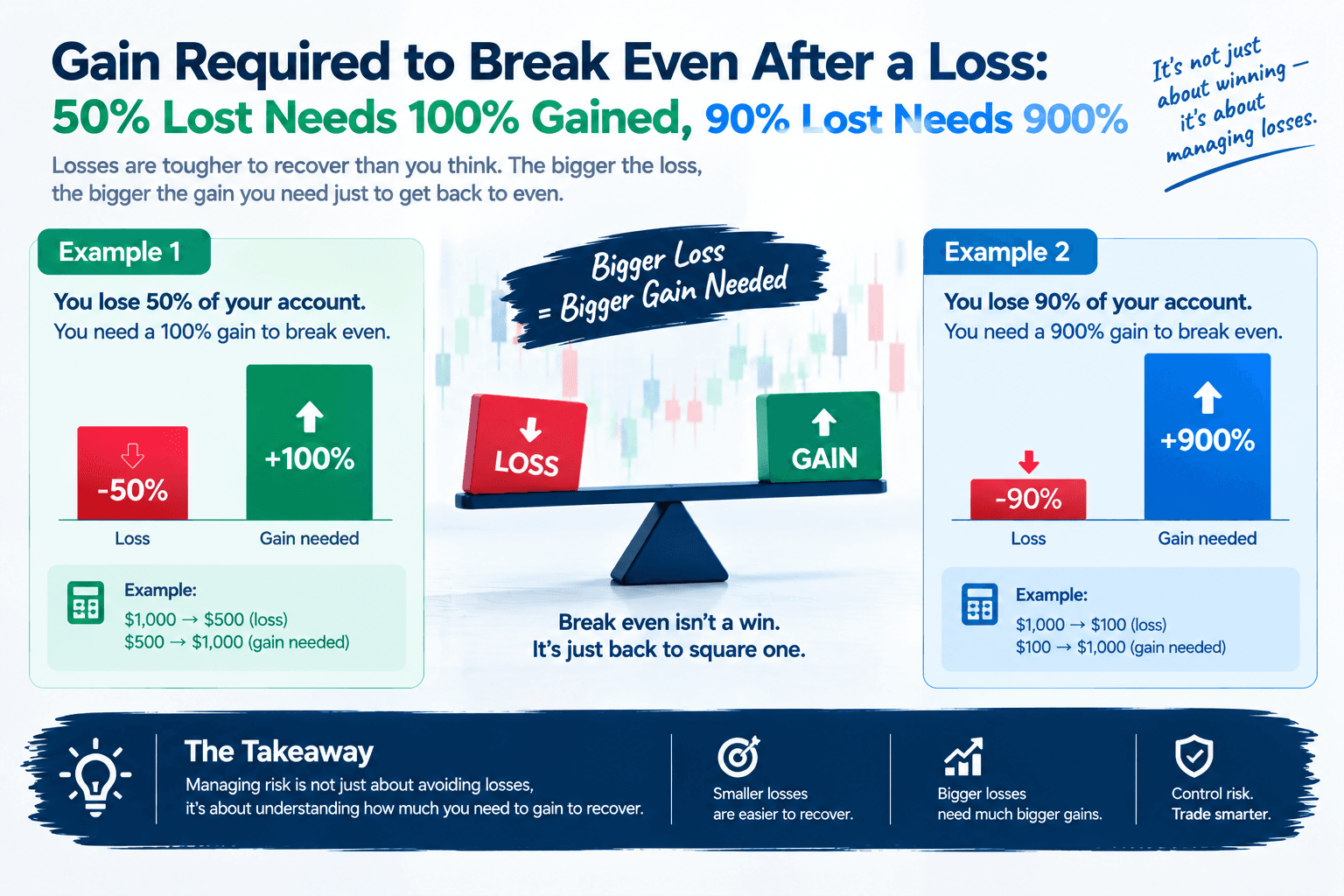
A percentage loss requires a larger percentage gain to undo. Not the same larger. And the gap widens fast.
You lose | You need, just to get back to even |
|---|---|
5% | 5.3% |
10% | 11.1% |
20% | 25% |
25% | 33.3% |
50% | 100% |
70% | 233% |
80% | 400% |
90% | 900% |
A 50% drawdown needs a double to break even. Not a good month a doubling, which is more than most professional traders make in a year.
Why the asymmetry: you are now earning on a smaller base. Lose half of $10,000 and your $5,000 has to produce $5,000 of profit, which is 100% of what is left.
The trap, in one line: the further you fall, the harder recovery becomes and the more tempting it becomes to take the kind of risk that makes the fall deeper.
Why sizing up is the worst available response, mathematically
The instinct after a losing run is to increase size, so that a win returns more. The reasoning feels sound: bigger positions, faster recovery. It is sound in exactly one direction and catastrophic in the other.
Doubling your position size does double the recovery speed if you win. It also doubles the rate of destruction if you lose and you are considering it precisely at the moment when the recent evidence about which of those happens is at its least encouraging.
Look at what it does to your survival margin. Using ABET’s published Standard account mechanics a 10% stop out level and a 100,000-unit contract an account with $2,000:
Position | Margin | Pip value | Room before stop out |
|---|---|---|---|
1 lot | $108.50 | $10 | 199 pips |
2 lots | $217.00 | $20 | 99 pips |
4 lots | $434.00 | $40 | 49 pips |
Four times the recovery speed, one quarter of the room to be wrong. After a streak of being wrong.
There is a structural version of the same point worth knowing: any strategy that increases size after a loss is a bet that the losing run ends before your capital does. Occasionally it does. The times it does not are the accounts nobody writes an article about.
The streak might be information, not bad luck
Losing runs happen to every strategy with a win rate below 100%. Seven losses in a row is entirely normal on a 50% strategy over enough trades. So the first question is not "how do I fix this" but "is this noise, or is it telling me something?"
MetaTrader 5 has already recorded the answer. Open the Toolbox → History tab → right-click → Report, set the period, and read four fields:
Field | What it tells you |
|---|---|
Maximum consecutive losses | Compare it with what your position sizing assumed. If you sized for three and got eight, the sizing was wrong not the market |
Largest loss vs average loss | If the largest is several times the average, that is not a losing streak. That is one trade where a stop was moved or removed, and you will remember which |
Profit factor | Below 1.0 over a meaningful sample is a strategy problem, not a luck problem |
Total trades vs expected payoff | A high trade count with a thin expected payoff is overtrading losses are spread cost accumulating, not a run of bad calls |
Those four fields separate a bad run from a broken process, and they cost nothing to read.
Almost nobody in a drawdown looks, because looking feels like confronting it. Looking is the cheapest thing available.
What ABET’s tools actually do and it is not recovery
The brief asked about tools. There are real ones. Every one of them works by making the next mistake smaller.
The Micro account. The genuine instrument here. One lot is 1,000 units instead of 100,000, so one pip is about $0.10 instead of $10. Everything divided by a hundred: every position, every error, every streak. Not a lesser account the same platform and instruments at a size where rebuilding a process costs almost nothing.
Lower leverage. Leverage does not change your risk on a given position it changes the largest position you can open. After a losing streak, lowering it removes the ability to act on the impulse this article is about. That is its entire value, and it is considerable.
The 30-day demo. If you are changing your approach, test the change without paying tuition for the test. A modification that survives a month on demo is a modification. One that has not been tested is a hope with a new name.
Stop losses and stop out levels. ABET’s stop out sits at 10% on Standard, 15% on Prime, 30% on Micro and 0% on Raw Spread. Micro’s earlier stop out closes positions sooner a disadvantage when you are right, and a protection when you are in the run this article describes.
Negative balance protection, on all four account types, is the floor. Not comfort the guarantee that the worst case stops at your deposit.
Notice what is missing from that list: anything that helps you win the next trade.
No broker has that tool, and any that claims to is selling something.
The signals that mean stop, not adjust
A broker has an obvious incentive not to write this section. It is the most important one. Stop if any of these is true:
The money lost was money you needed.
Rent, tuition, a loan repayment, anything borrowed. This is not a sizing problem to correct; it is a reason to stop entirely and seek advice.
You have increased position size after a loss more than once.
That is a pattern, and it is the specific pattern that ends accounts.
You have deposited again to "give it a fair chance" within days of a loss.
The fair chance was the first deposit.
The margin call or stop out has fired.
Those are not risk management they are what happens after yours has failed.
You are not telling people the truth about it.
Concealment is the most reliable signal there is, and it tends to arrive before the worst of the loss.
And the honest context: most retail accounts lose money at brokers required to publish the figure it sits in the seventies and eighties. Concluding "this is not for me" is not a failure. It is the correct conclusion for most people who reach it, and reaching it after four months costs far less than reaching it after four years.
One of these four exists, and it is not presented as a protective tool at all. Leverage is client-selectable per account, and the dropdown goes all the way down to 1:1 so anyone who wants to stop themselves opening a leveraged position can do it in ten seconds, without asking anyone. It is filed as a trading setting rather than a safeguard, and nothing points a client toward it for that purpose.
There is also a partial substitute for a deposit limit, again by accident rather than design. Deposits land in a wallet first, and each trading account is funded from it by internal transfer, which is free and unlimited. Keeping the bulk of a balance in the wallet and moving across only what a position needs caps what any single account can lose without capping what you hold. That is a workaround a client has to think of themselves.
What does not appear anywhere: a cooling-off period, a client-set deposit limit, or a temporary account suspension you can request. Nothing on abetglobal.com describes any such facility, and nothing in the portal offers one. Accounts do go inactive on their own after a period, but that is dormancy, not a tool you can reach for.
If these exist and are simply unpublished, publishing them costs nothing. If they do not exist, they are worth building they are the only mechanisms that address directly what this article describes, and the presence of them is one of the clearer signals of a firm that takes client outcomes seriously rather than stating that it does.
What recovery should actually mean
Not the balance. The process. A rebuilt process looks like this, and none of it is about the market:
1. Stop trading for a defined period. A week is enough. Not forever a defined pause, decided now.
2. Read the MT5 report. The four fields above. Write down what they say.
3. Decide whether the problem was strategy, sizing, or discipline. They have different fixes and only one of them is about the strategy.
4. Change one thing. One. Multiple simultaneous changes cannot be evaluated.
5. Test it on demo, or at Micro size. Long enough to mean something.
6. Set the size before you resume, in writing, and do not revise it upward for at least a month.
7. Accept the previous balance is gone. The hardest step, and the only one that makes the rest work.
The traders who come back are not the ones who made it back quickly. They are the ones who stopped trying to.
Risk warning
CFDs and leveraged forex are complex instruments and carry a high risk of losing money rapidly. Most retail investor accounts lose money. Increasing position size to recover losses substantially increases the risk of losing your entire deposit. Never trade with borrowed money or funds you cannot afford to lose. This article is general information, not investment advice. If trading losses are affecting your finances or wellbeing, consider speaking to a qualified financial adviser or a support organisation in your country.
Comments
Loading comments…
Sign in to join the conversation.